Nyala, August 12(Darfur 24)
Hussein Suleiman, a gum arabic trader in El Daein, East Darfur State, has lost hope of generating revenue from selling his stock of gum arabic commodity, where he resorted to relocating his family to Egypt after prices collapsed due to several factors he cannot control.
The trader spoke to Darfur 24 while sitting in front of his shop in the crops market in El Daein. He insisted on not selling his stock of gum arabic in light of the collapse of prices after local markets were flooded with huge quantities of the commodity, most of which were looted , and the emergence of new buyers who purchased the gum at low prices from producers and smuggled it to neighboring African countries.
However, the gum arabic belt extends across 13 states, but most production is concentrated in Kordofan and parts of Darfur, where the Rapid Support Forces control most of the areas containing the acacia forests that produce the commodity and also control its supply chains.
In October 2024, the RSF banned the import of agricultural and forestry products, including gum arabic, from areas under its control to the army-controlled states in central, northern, and eastern Sudan.
This decision, coupled with the appearance of new buyers who controlled market prices by purchasing any quantity of gum arabic sold in the market, and their connections to smuggling networks, led to the collapse in the commodity’s prices in the local markets.

Who are the smugglers?
Merchant Hussein reported that members of the Rapid Support Forces are marketing the gum arabic crop in neighboring countries via Chad and South Sudan.
Hussein noted that after the decision to ban the export of agricultural and forest crops, gum arabic accumulated in the markets. However, members of the Rapid Support Forces soon appeared, purchasing both old and new crops and marketing them in Chad.
Three identical sources from Nyala, South Darfur, who preferred to remain anonymous for security reasons, told Darfur 24 that ten trucks loaded with gum arabic arrived in the city during January, February, and March 2025 from the localities of Burum and Bahr al-Arab in East Darfur.
They indicated that these trucks are owned by brothers Hamid al-As and Omar al-As, who reside in Niamey, Niger, and are close to the commander of the Rapid Support Forces, Mohamed Hamdan Dagalo.
Sources reported that the trucks were unloaded and at Hamed’s home in the airport neighborhood, north of Nyala. Hamed collects and purchases the gum before transporting it to his brother in Chad and then to Niger.
Smuggling Outlets
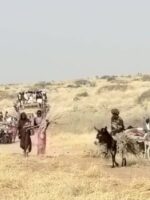
Ahmed Ismail, a commercial truck driver, said he transported approximately 30 tons of gum arabic for a trader from the Bahr al-Arab region to Chad via Nyala, Kass, Zalingei, and El Geneina, passing through the Adikong border crossing with Chad, and arriving in the city of Adré.
He indicated that he paid 700,000 Sudanese pounds to members of the Rapid Support Forces in Nyala and El Daein, and 1 million Sudanese pounds at the gates between Nyala and El Geneina. He also bribed authorities in El Geneina and the Adikong crossing with 500,000 Sudanese pounds.
Mohamed Osman, a truck driver, explained to Darfur 24 that gum arabic is smuggled from South Darfur via Raheed al-Bardi to the towns of Forobaranga and Umm Dukhun in Central Darfur State, both bordering Chad.
He indicated that the gum Arabic is smuggled via East Darfur to the Reguibat border crossing, and via another route through the Tamsaha area to the city of Boro in South Sudan, but in limited quantities.
The UN Panel of Experts on Sudan stated in a report published on April 30 that RSF commanders in Nyala turned a blind eye to the looting of gum arabic and other gum because it was viewed as compensation for them and their soldiers to ensure their continued fighting.
He spoke of RSF commander Humaidan Mohamed, under the command of Saleh al-Futi, overseeing operations in Nyala when the looting occurred.
Bakhit Ibrahim, a militia commander allied with the RSF, also controlled the roads linking Nyala, Zalingei, and El Geneina, which constitute some of the gum arabic transport routes.
The report stated that Gum arabic was smuggled through the Adré crossing between West Darfur and Chad, through Umm Dukhun in Central Darfur to Chad, through Umm Dafuq in South Darfur to the Central African Republic, and through Ed Daein to Aweil in South Sudan.
Local traders in East and South Darfur reported to the UN team that an estimated 3,700 tons of gum arabic were looted between January and June 2024.
The Rapid Support Forces (RSF) imposed a fee of one million Sudanese pounds on each truck carrying 20 tons in the Al-Ruqaybat and Al-Na’am areas on the border with South Sudan, and demanded a zakat tax of 100,000 Sudanese pounds on each truck.
He explained that 10 trucks carrying 20 tons and 20 small vehicles carrying varying quantities of gum arabic passed through Al-Ruqaybat and Al-Na’am weekly during the summer.
The RSF earns up to $20.5 million per month from the fees it imposes on the passage of gum arabic trucks, at a rate of 10 trucks per week.
The report explained that the quantities of gum arabic reaching the Chadian border in areas controlled by the Rapid Support Forces range between 50,000 and 70,000 tons annually.

Prices Decline
Traders and farmers from Darfur’s gum production belt told Darfur 24 about a decline in demand for the commodity from major buyers and well-known companies after the outbreak of the war, which has resulted in lower prices compared to pre-conflict prices.
Gum sales agencies in Buram locality, about 100 kilometers south of Nyala, have witnessed a decline in both production and supply.
Gum sales agency owner Taha Mohammed told Darfur 24 that the majority of farmers refrained from harvesting the crop due to irregular orders from agencies and low financial returns.
He explained that Gum arabic farmers have turned to working in the gold mines in Singo, noting that the price of a quintal of gum at the beginning of the current season last October reached 190,000 Sudanese pounds before rising to 220,000 Sudanese pounds at the end of the season last June.
He stated that the war has directly impacted gum Arabic production, explaining that local agencies in Buram and the Al-Qouz Al-Gharbi area were operating before the outbreak of the war.
During the conflict, 20 to 30 trucks loaded with gum arabic were sold weekly, heading to Nyala, then to Khartoum, and after that to export outlets outside Sudan. This season, however, agencies are selling ten trucks weekly, heading west to Chad.
Hussein Suleiman, a gum trader in the El Obeid market in North Kordofan, said that the exit of the El Obeid stock exchange(crops market ) in North Kordofan has significantly impacted the marketing of the crop, noting that all those currently involved in the gum trade are members of the Rapid Support Forces.
He stressed that the price of gum arabic (hashab) in the state’s markets ranges between 100,000 and 160,000 Sudanese pounds per quintal, which is unprofitable for both traders and farmers.
East Darfur is one of the most important gum arabic-producing regions in Sudan. According to pre-war statistics from the Ministry of Agriculture and Forestry in the state, production is estimated at approximately 65,000 quintals of gum arabic on a cultivated area of approximately 141,775 acres.
Gum Arabic Trader Daoud Hassan, from the Raheed El Bardi area of South Darfur State, stated that the price of a quintal of gum arabic (45 pounds) at the beginning of the season reached 200,000 Sudanese pounds, reaching 230,000 Sudanese pounds by the end.
Speaking to Darfur 24, he said that most of the production goes to Chad, where the price per ton (1,000 kilograms) reached 1,050,000 Sudanese pounds at the beginning of the season, equivalent to 750,000 Sudanese pounds. The price continued to rise until it stabilized at 2 million francs, equivalent to 800,000 Sudanese pounds, and is subject to increase.

Taxes and Fees
Saeed Ali, a trader in the Nyala market, told Darfur 24 that there is a scarcity in the supply of gum arabic, with an increase in demand. He explained that the price per quintal ranges between 270,000 and 300,000 Sudanese pounds, at a time when supply in the markets is declining.
Saeed pointed out that the majority of the production arriving at the Nyala Stock Exchange originates from the town of Khazan Jadid, northeast of Nyala, and the Bahr al-Arab region of East Darfur State.
Saeed attributed the scarcity of supply to the fact that large areas of Ed al-Fursan locality were out of production. He noted that the second largest market after Ed al-Fursan before the war was the weekly market in the Shuwaib area.
This market is considered a major source of gum arabic, which supplies the markets of Nyala city, with at least ten trucks shipped weekly.
Saeed attributed the scarcity and limited supply to smuggling via Chad from areas of southeast Darfur.
Production Decline
The war between the army and the Rapid Support Forces (RSF) has disrupted the gum arabic production belt in Darfur and parts of Kordofan, disrupting production chains from one region to another.
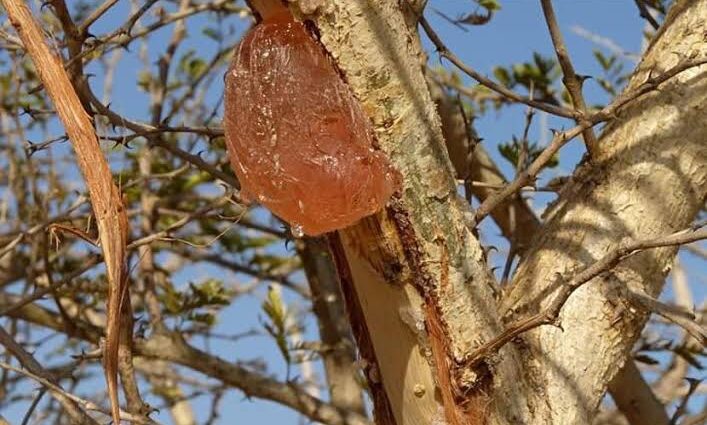
The RSF controls large areas of production for this important cash crop used in the food, pharmaceutical, and cosmetics industries worldwide. Sudan tops the list of Gum Arabic producing countries, with a production rate of 80% of global production.
A number of farmers from South, East, and Central Darfur states stated that the impact of the ongoing war in Sudan on gum arabic production has been evident in the shortage of labor and the loss of large areas of production has affected harvesting of gum arabic, which typically begins in December and continues until early June.
They added, “The excessive felling of trees over the past two years has led to the loss of these areas, in addition to the involvement of some young farmers in fighting alongside the Rapid Support Forces, which has resulted in a scarcity of supply, especially in the markets of Nyala.”
In contrast, local producers from the Katila area, southwest of Nyala, told Darfur 24 about higher production this season compared to last year in the areas of Haraza, Qoz Arabi, Buhairat, Timsah, Sin El Fil, Qarf El Arous, Areeda, Kreinak, Kabshin, Shatin, and Hashaba.
Farmers in Katila, which is famous for growing gum arabic trees, estimated average production this season at more than 40 quintals per acre since the beginning of the season.
Farmer Abu Ibrahim told Darfur 24 that the price of a quintal of gum arabic initially stood at 100,000 Sudanese pounds, but increased to more than 225,000 Sudanese pounds in April and May.
He added, “The civilian authorities affiliated with the Rapid Support Forces impose a fee of 5,000 Sudanese pounds per quintal, in addition to fees paid to the Rapid Support Forces’ military personnel on all trucks carrying gum arabic, which can reach a maximum of 200,000 Sudanese pounds at the exit gate of the city.”
He continued, “The production sent to the Nyala markets is much less than that smuggled into Chad via the border town of Forbaranga.”
He pointed out that four to six trucks carrying gum arabic to the markets each week range from one truck to another, with an average load of 50 quintals per truck.
Chad Exports
Ibrahim Abu Bakr Al-Siddiq, Deputy Secretary of the Chamber of Gum Arabic Exporters, told local media that the new “BFT” import system adopted by China has granted Chad a special code for importing gum arabic and peanuts.
He pointed out that Sudan, despite its competitive advantage in these products, is at risk of losing its market share due to increased smuggling to Chad and South Sudan.
He confirmed that the Gum Arabic Union has received information indicating that a large portion of the gum imported by Chad is originally Sudanese and has been smuggled Chad.